The world is losing biodiversity at an unprecedented rate. The Living Planet Index measures the state of the world’s biological diversity. Despite global efforts, it has declined by 68% since 1970. Even growing awareness of the interdependency of human life and the natural world has not prevented acceleration in species extinctions. At the same time, mounting evidence suggests that biodiversity conservation is a critical development issue, particularly for the poorest and most vulnerable economies.
Global biodiversity conservation efforts must be increased. The December meeting of COP-15 (the Conference of the Parties to the Convention on Biological Diversity ( CBD)) can catalyze transformative action by adopting a new global biodiversity framework and more ambitious targets for 2030. Dubbed as the “new deal for nature and people”, the framework promotes broad-based action to transform society's relationship with nature. Its holistic approach identifies drivers of biodiversity loss across all economic sectors, brings nature’s value into decision-making at all levels, and aligns financial flows with biodiversity goals.
Limited data and analytics have impeded progress . Biodiversity conservation worldwide has been hindered by limited public-domain information on critical ecosystems, biodiversity, and habitat. In addition, many datasets are difficult to access and use, especially in the developing world, and traditional biodiversity metrics have often been limited to information on terrestrial vertebrates supplied by the International Union for Conservation of Nature (IUCN) and BirdLife International. There is an increasing set of free/public-domain data, cloud analytics, visualization, and e-packaging building on technological advances that could help greatly. Conservation efforts are also hampered by the mismatch between rapidly-developing threats to biodiversity and long update cycles for even basic information curated by financially-challenged biodiversity institutions, and there is a need for urgency to work together provide appropriate information to facilitate decisions that could help protect global biodiversity.
The World Bank has been supporting various aspects of biodiversity conservation as part of its investments in protected areas, other conservation, and as part of the ESF (ESS6) environmental due-diligence for projects. Biodiversity is also being explored as part of nature-based systems that are being explored from a climate, jobs, and financing perspective. These efforts face the same constraints of limited public-access data and analytics.
Broadening public information access
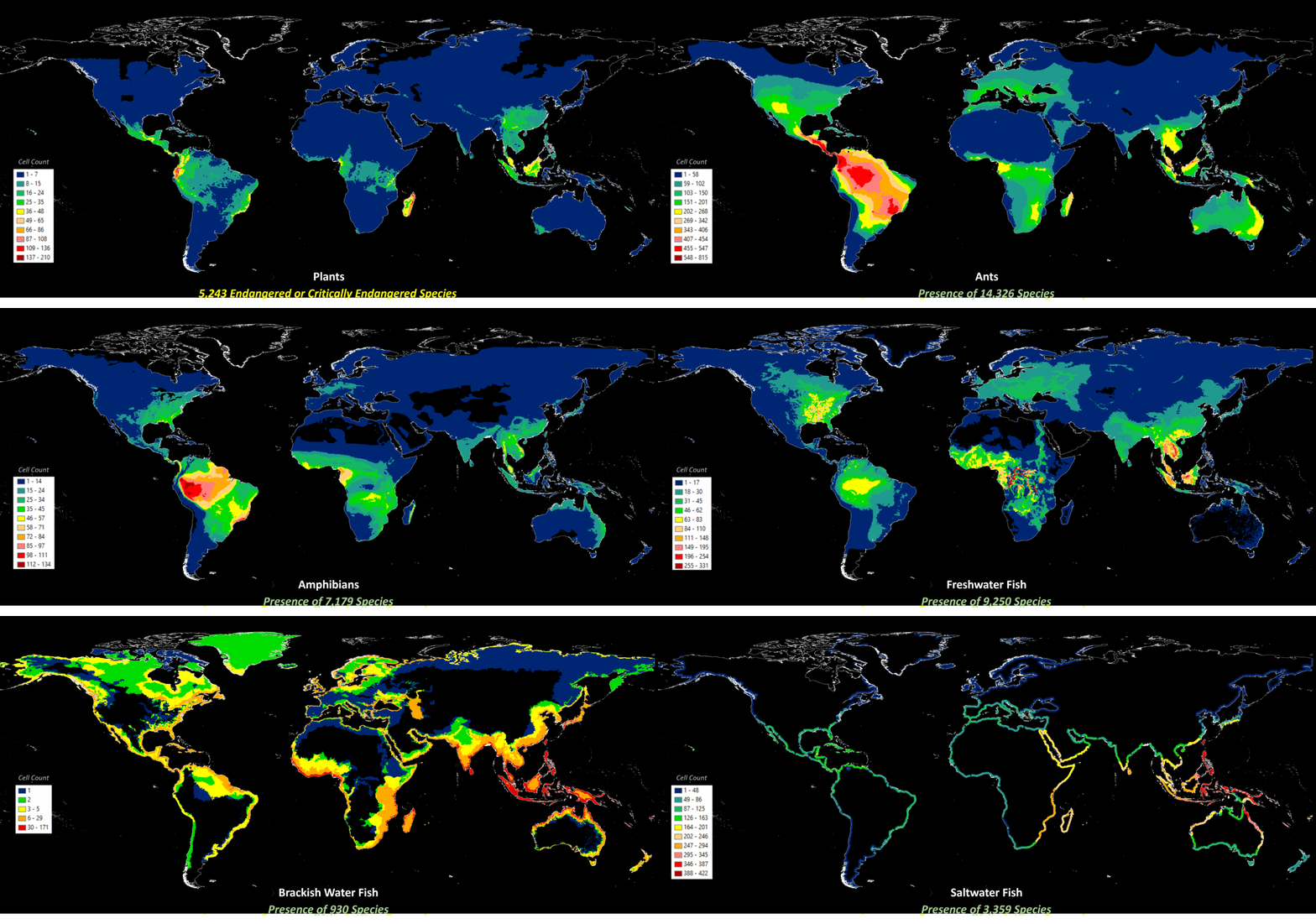
The World Bank is supporting the new global biodiversity framework with a 2.5 yr Global Biodiversity Data and Analytics Services ( GBDAS) initiative supported by a Global Environmental Facility (GEF) Medium-Sized Project that has recently been initiated to facilitate access and use of global biodiversity data and analytics services. This initiative (co-led by ENB and DEC with other internal and external partners) seeks to help improve awareness, enhancement and use of available free/public-domain biodiversity and related data and analytics to support biodiversity conservation and environmental due-diligence efforts. It is collating relevant data to expand traditional coverage of terrestrial vertebrates to include aquatic biodiversity (e.g. freshwater, brackish water and saltwater fish), plants, and invertebrates (e.g. ants). The database currently incorporates publicly-available habitat maps for over 90,000 species, as well as information on extinction risks, endemic species and species whose extremely small ranges make them particularly vulnerable. GBDAS coverage includes 33,518 terrestrial vertebrates and 60,945 fish, plants, and invertebrates (which more than doubles the number of species that are rated Endangered or Critically Endangered by the IUCN). The database currently includes over 38,000 endemic species and over 2,000 species with extremely small habitats (less than 25 square kilometers) and indicates why this issue is critical for all countries globally.
Operational biodiversity data at your fingertips
The initiative is also developing several e-packaged products (e.g. dashboards e-books/storymaps, case studies, and learning/outreach events in collaboration with ITS and OLC) that help users visualize biodiversity and other development data drawn from the World Bank’sDevelopment Data Hub,ITS Geospatial Platform, and the Spatial Agent App. These dashboards support the new holistic framework with a wide range of analytical/visualization tools for integrating biodiversity data with other environmental and development-related information.
Expanded publicly-available biodiversity data will support more holistic approaches by the World Bank and other development partners, as well as informing the designation of protected areas and stakeholder-designed biodiversity and threat indicators. These could include identification of key biodiversity locations outside of protected areas (e.g., 30 by 30 -- see Dinerstein et al. 2019 ); other effective area-based conservation measures (see CBD Decision 14/8 on Key Biodiversity Areas); ecological risk reduction for new infrastructure projects through environmental due-diligence; and integration of biodiversity information with the development dialogue.
New insights and opportunities for conservation stewards
First-stage development of the GBDS has provided the following insights. More will undoubtedly emerge as the stakeholder community engages with this new information source.
- The expansion of species coverage beyond current “keystone” groups greatly expands the set of countries that are key conservation stewards. New species groups have low locational correlations with current “keystone” groups, so expanded coverage changes the locational basis for priority-setting and “hotspot” identification.
- Expanded coverage of endemic species and a flexible definition of endemism deepen our understanding of countries’ conservation stewardship, as well as providing new information for priority-setting.
- Introduction of small-range species adds new threat information for priority-setting and another dimension of conservation stewardship. Small-range species are particularly vulnerable because large-scale industrial and agricultural projects may quickly eliminate their habitats.