Introduction
This Livable Landscapes eBook is part of the global knowledge curation activities (a new 10-year Global Knowledge Platform and a WBG Knowledge Academy) to leverage digital technologies to improve access to insights for modern landscape management. The Livable Landscapes eBook is part of the Livable Landscapes Academy, described in detail in the Annex here. This overall ePackaging is expected to grow over time to include better access to data, analytics, AI and knowledge resources and enable those working on addressing landscape degradation to learn from their counterparts around the world. It is also expected to be leveraged for the knowledge exchange and impact program activities planned under the Academy to help translate and customize this knowledge for specific settings.
The impetus for the creation of the Livable Landscapes Academy is to address the challenges of current levels of land degradation and the opportunities in reducing land degradation and restoring land.
Land Degradation Challenges and Opportunities
| Challenges | Opportunities |
|---|---|
|
|
The World Bank and Integrated Landscape Management
The World Bank has a current engagement to develop the Livable Landscapes Academy (the LLA), a 10-year Global Knowledge Platform of which this e-book is a component, with a focus on innovations in technology, policy and financing that can support integrated landscape management. The LLA will focus on knowledge curation, knowledge exchange, and impact. The Bank is also engaged in the China-WBG Global Center for Ecological Systems and Transitions which underscores China’s extensive experience in landscape management. The Center will focus on knowledge curation and analytics, exchange and learning, and country engagements and partnerships.
The World Bank’s Livable Landscapes Academy follows from a long history of the Bank being actively involved in advancing integrated landscape management through knowledge creation and dissemination, investments and projects, and partnerships. The Bank has been a participant in the Rio Conventions established at the 1992 UN Conference on Environment and Development, and under which countries convene and adopt goals at Conferences of Parties (COPs). The three COPs established through the Rio Conventions all involve landscapes and bring the interrelated issues of climate change, biodiversity, and desertification together.
(1) UNFCCC COP on Climate Change – Focused on climate mitigation pursuant to the Paris Agreement, development of national climate plans called Nationally Determined Contributions (NDCs) and National Adaptation Plans (NAPs).
(2) Convention on Biological Diversity COP on Biodiversity – Focused on biodiversity and ecosystem conservation, and implementing the Kunming-Montreal Global Biodiversity Framework.
(3) UNCCD COP on Desertification – Focused on reversing land degradation and desertification.
The World Bank’s presence at the 17th UNCCD COP included multiple events on sustainable finance, water security, landscapes and jobs, and food security. The storymap below details the Bank’s approach to investing in landscapes for jobs and growth.
Further, the Bank has a long history of investments in landscapes and the landscape approach within its project investments. The Bank’s Biodiversity, Ecosystems, and Landscape Assessment (BELA) Initiative “... promoted the use of ecosystem-services-informed landscape analytics and project planning to enhance the effectiveness and long-term sustainability of investments in agriculture, water resources, forestry, nature-based tourism, infrastructure, and to boost countries’ resilience to climate change“. The interactive tool below allows users to search and view the Bank’s portfolio of landscape-scale projects.
This section provides background information with interactive materials covering key concepts relevant to a landscape approach:
Definition and discussion of what constitutes a “landscape”.
Discussion ofland degradation across landscapes globally.
Definition and discussion of integrated landscape management – the “landscape approach”.
Discussion of options to mitigate land degradation through the landscape approach.
Overview of thelandscape types included in this e-book: drylands/rangelands, forests, and coastal areas.
This section provides a brief introduction to each of these concepts to guide later material; the concepts are then considered in more detail and illustrated through examples and case studies in subsequent sections of the eBook. You can navigate to relevant sub-chapters below:
What is a Landscape?
The term “landscape” has a diversity of definitions based on the characteristics of land use, physical features, history, and other elements. The World Bank defines a landscape as a socioecological system with spatial and geographic boundaries and functions and includes topography, natural resources, biodiversity, and various land uses. It is influenced by climate and culture as well as human activity. The boundaries of a landscape can be defined by a watershed, an administrative unit of government, an ecological area, a land feature, or any combination of these.
For the purposes of this eBook, a landscape is any part of the earth that is a contiguous spatial entity and is relevant from a development perspective. This flexible definition means that “landscapes” can refer to watersheds at different scales; large administrative regions with common climatic conditions (e.g. the countries of the Sahel); geographic regions with similar climatic and terrestrial or marine conditions (e.g. mountain landscapes, desert landscapes, or even coastal areas as part of seascapes); agricultural areas; and even urban areas. The graphics below depict a typology of landscapes. The image below shows different types of landscapes so defined.
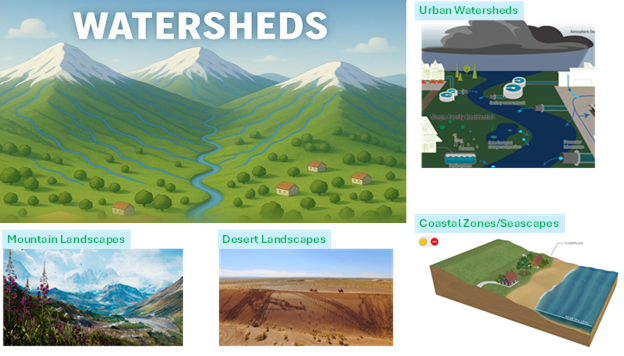
A multitude of landscape types exist, and can be distinguished via multiple lenses, including by landcover (forests, rangelands, coastal and urban areas), land use (rangelands, agriculture), geographic setting (climate, topography, distance to water), and implementation context (population density, conflict status, economic development levels). The Landcover Explorer below allows the user to select any location on earth and returns the landcover at a 1-kilometer resolution for that specific area.
Another mapping tool for landscape types is provided below, and allows the user to click on the parameters list and adjust the transparency of the output.
Watersheds are one example of a landscape system unit that is increasingly used for planning and prioritization. Watersheds can be aggregated at different scales, from a small mountainous micro-watershed to a large trans-boundary watershed such as the Nile basin. Watersheds are an appropriate and effective unit for managing ecological assets given the interconnected nature of activities and management impacts within a watershed both locally and regionally as well as upstream and downstream. For example, watershed management practices in upstream countries can impact social, economic, and environmental conditions in downstream countries within these watersheds. Land management practices within a watershed (e.g., deforestation and forest degradation; road and other infrastructure construction) can likewise have downstream impacts, such as increasing sediment load at downstream hydropower facilities. Road construction practices can also contribute to landslides, further increasing sediment load in waterways. The unsustainable overuse of water supply for consumption and irrigation and dam construction and use in upstream countries may impact the quantity and quality of water available in downstream countries. The image below shows the different spatial scales of watersheds.
Every point on earth belongs to a watershed: the interactive tool below draws the watershed around any point in the world, showing the drainage basin the area belongs to.
What is Land Degradation?
Land degradation is a significant planetary challenge.
- About 2 billion hectares of land is considered degraded and about 100m ha are being added to this annually.
- About 40% of the planet’s agriculture land is damaged, and more than three-quarters are experiencing drier conditions. 500m ha of agricultural land is abandoned due to degradation. Even if 300m ha of this was restored, we can ensure food security for all by 2050 (source).
- About 2 billion tons of dust are emitted into the atmosphere primarily from deserts and other degraded lands
- Drylands make up a third of the global landmass
- As part of the UN Decade on Ecosystem Restoration, the international community has pledged to restore one billion ha of degraded land (an area larger than China) by 2030
About 1.5 billion hectares of land is already considered degraded, and the world is losing an additional 100 million hectares of land each year due to land degradation. In response, the UNCCD has called on global leaders to adopt a “crisis footing” to confront this converging set of ecological and socio-economic risks. The map below shows the countries that have the highest shares of degraded land – with hot spots of degradation in Mexico, east Asia, and parts of Africa.
Land degradation is one of the most urgent yet underappreciated threats to sustainable development.Land degradation undermines ecosystems that sustain food production, water security, climate regulation, and economic resilience. Land degradation is the loss of land productivity across a range of sectors, such as the loss of economic and biological productivity. Land degradation leads to desertification, biodiversity loss, and the loss of soil health upon which agriculture depends. The video below provides an overview of what land degradation is.
Human activity has already altered nearly 70% of the Earth’s terrestrial surface, with up to 40% of land classified as degraded. From eroding soils in South Asia to desertifying rangelands in sub-Saharan Africa and deforested tropical frontiers in Latin America, the impacts are global and accelerating. If current trends persist, an additional 16 million square kilometers, an area nearly the size of South America, could degrade by 2050, exacerbating poverty, food insecurity, climate volatility, and geopolitical instability. In response, the UNCCD has called on global leaders to adopt a “crisis footing” to confront this converging set of ecological and socio-economic risks. The video below provides information on the benefits of land restoration to address the threats of land degradation.
Land degradation is driven by deforestation, overgrazing, unsustainable agriculture, mining, and urban expansion. These human-induced activities lead to a decline in soil fertility, water quality, and overall ecosystem productivity. As natural habitats are fragmented or lost due to deforestation, countless species lose their breeding, feeding, and migration grounds, thereby accelerating biodiversity loss. Degraded lands support fewer species and provide limited ecosystem services, such as pollination, carbon storage, and water regulation. Restoring land degradation is crucial for halting biodiversity loss and achieving global goals for land and ecosystem resilience. The interactive map below provides information on the share of land that is degraded in certain countries – users can click on specific countries to view the data.
At its core, land degradation is a landscape-scale development challenge with ecological, economic, and social dimensions. It diminishes agricultural productivity, increases exposure to climate extremes, drives biodiversity loss, and weakens the resilience of rural communities. Its consequences fall disproportionately on low- and middle-income countries, where land-based livelihoods are most common and the capacity to restore degraded landscapes is most constrained. Yet the costs are not confined to the developing world. Degradation destabilizes markets, weakens food supply chains, and imposes growing risks on financial systems and public institutions globally. This is why reversing land degradation is now central to achieving the Sustainable Development Goals (SDGs), fulfilling climate commitments under the Paris Agreement, and ensuring global economic resilience. SDG15, “Life on Land”- explained in the video below - is focused on protection, restoration, and sustainable use of land-based resources.
Protecting landscapes from degradation and restoring already degraded lands is critical to ensuring long-term ecological, economic, and social resilience. Restoring damaged areas helps to counteract these trends. Restoration is not only an ecological benefit but also a social one as it improves food and water access, stabilizes communities, and enhances health systems.
Reversing landscape damage calls for a thorough plan anchored on three pillars that comprise a hierarchy of desirable actions: avoiding degradation, reducing degradation, and restoring degraded areas. Reducing deforestation, expanding protected areas, and defending indigenous and community land rights constitute part of the protection of intact landscapes. These steps guarantee the preservation of ecosystems with great carbon value and biodiversity as well as their ongoing provision of necessary functions. The video below illustrates how reducing land degradation can be climate mitigation solution.
Degradation of a landscape is reversible rather than inevitable. This e-book provides solutions using an integrated landscape approach that can create ecological and societal resilience by safeguarding what is left, reducing further deterioration of the landscape, and healing damaged areas. Restored landscapes improve community well-being, increase economic activity, and support biodiversity, but we need to act right now.
Land Degradation Drivers & Consequences
This section describes the drivers of land degradation and the consequences of degradation for development activities. While the drivers and the consequences of land degradation are discussed in turn from an environmental, economic, and social perspective, processes in each sector interact with the others to magnify threats and increase degradation.
Key Facts about Land Degradation
TheGlobal Assessment Report on Biodiversity and Ecosystem Services (2019) reports that:
75% of the Earth’s land surface has been significantly altered, a process referred to as negative land transformation (e.g., deforestation, infrastructure development, overgrazing).
Over one-third of the terrestrial land surface is now used for agriculture (cropping and animal husbandry).
Urban areas have doubled in size since 1992—in less than 40 years.
Land degradation has led to reduced productivity on 23% of the global terrestrial area.
66% of ocean areas are experiencing increasing cumulative human impacts (e.g., pollution, overfishing, climate change).
A global map displaying where land degradation and desertification is occurring in the drylands from human activity and climate change is shown below.
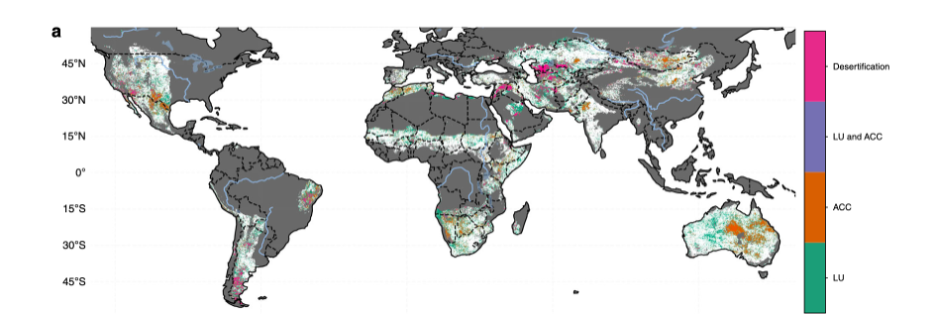
Source:Nature CC 4.0
Land degradation has significant and deleterious impacts on people and biodiversity (see box below) and has become one of the most significant and underappreciated constraints on economic productivity and long-term development. Globally, between one-fifth and two-fifths of terrestrial land is degraded, and human activity has altered nearly 70 percent of Earth’s land surface. The economic consequences are substantial. Degradation reduces agricultural productivity, weakens ecosystem services such as water regulation and carbon storage, increases exposure to climate shocks, and undermines the stability of land-dependent value chains.
Impacts of land degradation to people:
3.2 billion people globally (and 40% of the world’s poorest) are impacted by land degradation.
50 million people may have to migrate over the next 10 years due to desertification.
6 out of 10 people live in areas that experience water stress for some time of the year.
40% of local conflicts globally from 1946 to 2008 were triggered by natural resource use issues.
Source: The World Bank
One of the most significant impacts of land degradation on people is the employment impact. Job creation has emerged as a central priority of the development agenda, reflecting growing concern over employment outcomes amid slowing global growth, demographic pressures, climate risk, and rising fragility. Across low- and middle-income countries (LMICs), the development challenge is no longer limited to expanding employment in aggregate terms, but increasingly to creating jobs that are productive, resilient, and capable of sustaining livelihoods over time. These concerns are particularly acute in sectors and regions where economic activity remains closely tied to natural capital and land-based systems. Estimates suggest that the annual economic cost of land degradation exceeds trillions of dollars, with impacts falling disproportionately on LMICs, where land-based livelihoods predominate and adaptive capacity is limited.
Impacts of land degradation on biodiversity:
Over the past 300 years, 87% of the world’s wetlands have been lost, with a staggering 54% decline since 1900 (Source: IPBES, 2018).
1 million species—around 25% of assessed plant and animal species—are currently at risk of extinction, and the abundance of native species has declined by an average of 20% in most major terrestrial biomes. (UNCDD, Global Assessment Report on Biodiversity and Ecosystem Services, 2019)
By 2050, biodiversity loss is projected to reach 38–46%, primarily driven by human-induced pressures viz., habitat transformation (e.g., forests to farmland) and habitat degradation (IPBES, 2018).
The economic cost of biodiversity and ecosystem services loss from land degradation is over 10% of annual global gross product.
The degradation of the Aral Sea is a striking example of large-scale land degradation caused by unsustainable water management. The diversion of the Amu Darya and Syr Darya rivers for irrigation led to the sea shrinking by over 90%, exposing vast areas of saline land and toxic dust. This has resulted in the collapse of ecosystems, agricultural productivity, decline in fish catch, and severe public health issues in this region. The video below illustrates the impact of land degradation in the Aral Sea.
Options to Mitigate Land Degradation
Methods to combat land degradation include avoidance of degradation in the first place, reducing degradation, and restoring already degraded areas.
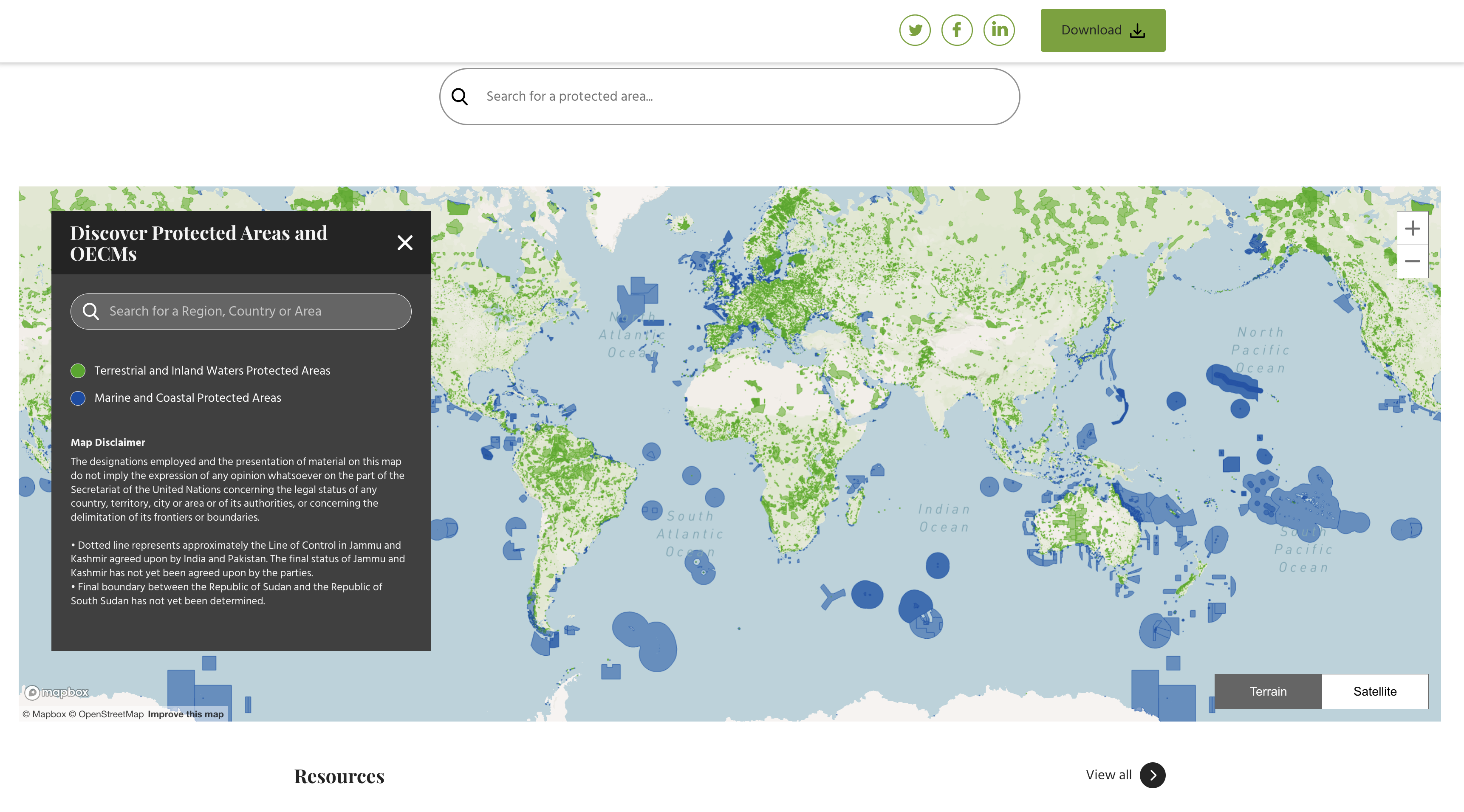
Avoiding degradation encompasses a broad suite of potential activities that protect land before it is damaged. The avoidance of land degradation is centered on maintaining already healthy ecosystems and landscapes to protect them from the threats (e.g., unsustainable agricultural or grazing practices) that cause degradation. Establishing and properly stewarding protected areas is an example of an avoidance measure. The interactive map below provides information from the World Database on Protected Areas (WDPA) for terrestrial and marine protected areas.
Reducing degradation includes adoption of sustainable land management techniques to slow down continuous deterioration. Among these are better land-use planning, regenerative farming, and climate-wise friendly agriculture. Early warning systems and real-time data monitoring of ecosystems also enable fast response to indicators of stress or harm. The video below illustrates the benefit of reducing land degradation through the lens of improving nutrients and carbon sequestration.
Restoring degraded land is about returning once deteriorated areas to life. Nature-based methods include agroforestry, reforestation, wetland rehabilitation, and rewetting of drained peatlands to help to accomplish this. These areas can then be protected to avoid future degradation through interventions such as establishing protected areas. Furthermore, supporting economic recovery and community empowerment is investing in green jobs and restoration-oriented businesses. The video below illustrates how nature-based solutions can be used for land restoration.
What is Integrated Landscape Management?
As defined, landscapes are useful spatial units through which to manage multiple social, economic, and environmental challenges through a landscape-scale approach. The World Bank defines a landscape approach as “managing multiple land uses in an integrated manner, considering both the natural environment and the human systems that depend on it.” In this context, integrated landscape management means the development, prioritization, and implementation of balanced solutions that consider social, economic, and environmental challenges and goals. This is a collaborative rather than a sectoral approach that aligns interventions, where for example agricultural production would be considered together with addressing social, economic, and environmental processes that degrade soil. The benefits of using a landscape approach are significant and meaningful.
Integrated landscape approaches have been piloted, scaled, and refined in numerous regions across the globe and provide lessons on emerging global good practices. These existing and evolving efforts have leveraged ever-increasing datasets and the emerging and innovative technologies that help us to process these data and develop operational insights from them. Key to addressing land degradation is catalyzing additional funding and finance for these projects. It is estimated that an annual investment of $700 billion is required for additional public and private finance to reverse nature loss (current investments are estimated to be around $120-140 billion annually).
The World Bank supports implementation of integrated landscape approaches through lending and non-lending activities (e.g., knowledge creation and dissemination); trust funds; and partnerships. A useful resource to understanding the landscape approach is the World Bank Open Learning Center’s course on Landscape Approach 101 self-paced course. For lending activities, the integrated landscape approach can be implemented at both the project and portfolio level. Examples of Bank projects that have taken an integrated landscape approach include the Turkey Resilient Landscape Integration Project (TULIP), and the Integrated Forest Landscape Management Project in Atalaya, Ucayali, Peru.
An example of an integrated portfolio approach is Mozambique's Integrated Landscape Management Portfolio (ILM), a portfolio of projects that “promote the sustainable management of renewable natural resources (forests, wildlife, land, and fisheries) and improve livelihoods in the country’s most vulnerable rural communities.” The video below illustrates ILM through this project.
The graphic below shows how an integrated landscape approach is implemented in Mozambique through this diverse portfolio of intentionally interacting projects.
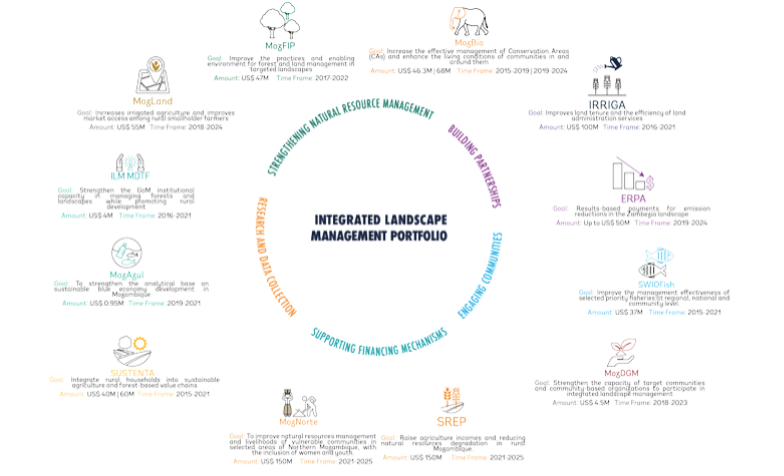
Source: World Bank Group
Taking a multisectoral landscape approach has been proven as an effective method to combat land degradation while generating critical co-benefits such as job creation and climate resilience. Landscapes - defined as socioecological systems with spatial and geographic boundaries and functions - are useful spatial units through which to manage multiple social, economic, and environmental challenges. The World Bank defines a landscape approach as “managing multiple land uses in an integrated manner, considering both the natural environment and the human systems that depend on it.” In this context, integrated landscape management means the development, prioritization, and implementation of balanced solutions that consider social, economic, and environmental challenges and goals. This is a collaborative rather than a sectoral approach that aligns interventions, where for example agricultural production would be considered together with addressing social, economic and environmental processes that degrade soil. The benefits of using a landscape approach are significant and meaningful.
Landscape management challenges can be addressed with a combination of the 3Is – Information, Institutions and Investments and an effort to integrate these approaches.
Information:One of the major approaches in better managing landscapes is to improve the data, information, and knowledge base to better inform decisions related to planning and operations. Landscapes can be better managed through the use of Monitoring Systems (in-situ, earth observation, crowdsourcing), Analytics (basin, precipitation-sheds, land use planning) and making associated data and knowledge publicly accessible.
Institutions:The multi-sectoral nature of landscape management requires effective institutional frameworks to be in place among public agencies and local communities, with clear arrangements for integration across often fragmented local and higher level agency mandates, and for interagency collaboration (not only across administration levels but also across government, academia, private sector, CSOs, and communities). Therefore, the institutional framework for landscape management can be complex and very often faces several challenges to success, depending on the institutional conditions of every landscape.
Investments: The needs for investments in landscape management are multiple and respond to a variety of objectives. There are two main types of investments: those in monitoring systems,for generatinginformationabout the status of various variables on the landscape; and on infrastructurefor sustainably managing the landscape. For investments to be efficient, sustainable and appropriate there are a number of commonly occurring challenges that require overcoming.
Integrated landscape approaches can be taken at both the project and portfolio level. Individual projects can incorporate landscape approaches, and multiple of these projects can be combined into a portfolio of sector projects that intentionally speak to each other to bolster social, economic, and environmental outcomes as healthy landscapes are protected and degraded landscapes restored.
One example of an integrated landscape approach at the portfolio level is the Mozambique Integrated Forest and Landscape Management Portfolio , the goal of which is to enhance the living conditions of communities through the sustainable use of forests and other natural resources (visualized in the image below).
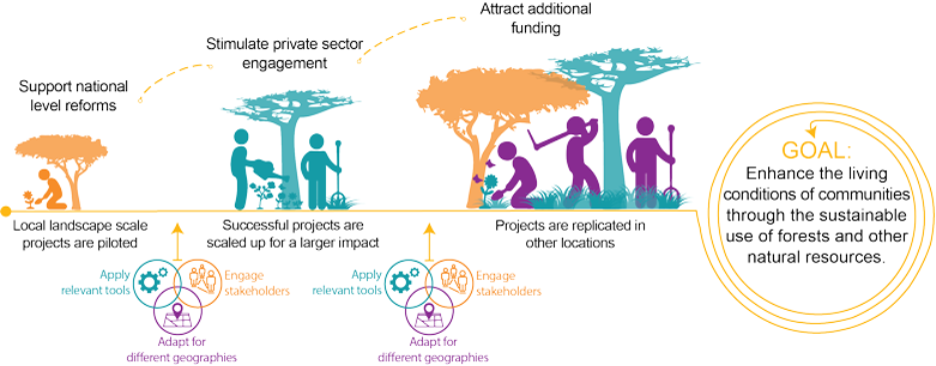
Source: World Bank Group
Another example of a portfolio approach to integrated landscape management is provided below, from the World Bank’s Sustainable Landscape Management Program (SLMP) activities in Indonesia. As shown, multiple pillars comprise the SLMP that address aspects of land administration and governance, improved forest management, social and economic equity and growth, funding, and stakeholder engagement.
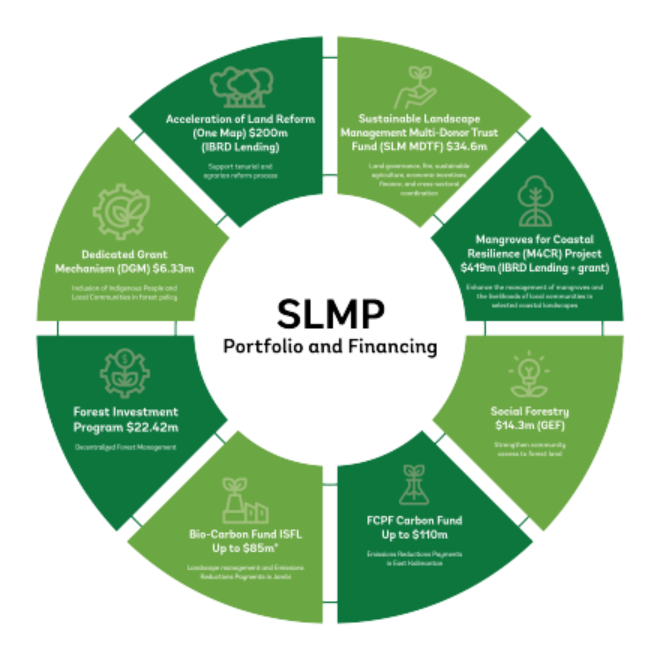
Source: World Bank Group
Benefits of Integrated Landscape Management
The development benefits of Integrated Landscape Management (ILM) are numerous, and include benefits for social, economic, and environmental sectors. For example, ILM increases climate resilience, food and water security, species and habitat protection, and rural livelihoods.
One of the key benefits of integrated landscape management that is cross-cutting across the social, economic, and environmental sectors is jobs. The additional job opportunities created by restoration, conservation, and other actions can benefit local communities, and if implemented intentionally, women and other marginalized groups, through providing increased income and employment that positively benefit livelihoods. The environmental uplift and benefits created by environmental restoration can also positively impact livelihoods through agricultural productivity increases and other benefits (cleaner water and air, improved natural resources conditions) that environmental restoration activities provide.
Jobs
A key development implication of ILM is the positive impact ILM can have on jobs and employment, thereby supporting livelihoods in some of the most challenging ecosystems. Livable landscapes sit at the intersection of employment dynamics. Landscapes underpin agriculture, tourism, infrastructure development, energy systems, and value-added manufacturing, sectors that together account for a large share of employment and income generation in developing economies. The condition of land, soils, vegetation, and water systems directly shapes labor productivity, the viability of local enterprises, and the durability of jobs across these sectors. Yet landscape-related interventions have historically been framed primarily through environmental, climate, or conservation lenses, with limited attention to how land management choices translate into employment outcomes at scale.
Understanding how landscapes generate employment requires moving beyond aggregate claims about job creation to examine the concrete forms of work embedded in restoration and sustainable land management processes. Landscape interventions mobilize labor across a wide range of technical, operational, and service functions, extending from planning and biological production to field implementation, maintenance, and long-term stewardship. These activities shape not only the volume of employment generated, but also the duration, skill content, and stability of jobs associated with landscape-based investments.
Landscape restoration translates into employment not only through visible field activities but through the technical and managerial work required to identify priorities, design interventions, and to sequence implementation across space and time. Restoration initiatives commonly begin with site assessment and planning tasks, such as landscape diagnostics, feasibility and risk assessment, and the selection of intervention types that determine whether solutions rely on engineered assets, ecosystem functions, or hybrid approaches. Forest and landscape restoration practice similarly emphasizes early-stage processes such as site selection, baseline assessment, and the definition of restoration pathways as foundational steps that shape implementation choices and downstream resource needs. These planning functions imply an associated set of roles, technical teams that generate evidence, set priorities, and develop intervention designs, as an integral part of restoration delivery rather than an optional add-on.
A distinct cluster of restoration-related work is associated with nurseries and seed systems, which supply biological inputs for planting, enrichment, and other interventions that require introducing or supplementing vegetation. Assisted natural regeneration (ANR) is framed as an approach that deliberately builds on natural processes of recovery and regrowth, often reducing reliance on planting while still requiring active management and protection measures to enable regeneration. When planting-based approaches are selected, forest landscape restoration guidance emphasizes the operational necessity of sourcing appropriate planting material and organizing planting methods to match local ecological conditions and restoration objectives. This implies employment across seed collection, propagation, nursery management, seedling handling, and transport logistics as part of the supply chain that enables field implementation.
Field implementation commonly combines site preparation with either planting-based work or regeneration-support measures, creating labor needs that extend beyond one-off campaigns. ANR-based restoration approaches emphasize active measures to reduce barriers to natural regeneration, including managing competing vegetation and protecting naturally regenerating seedlings. Through repeated, targeted actions over time, ANR sustains recovery trajectories rather than a single intervention moment. In many landscapes, invasive species control is an integral component of restoring ecological function, involving prevention, control, follow-up treatment, and long-term monitoring to prevent reinvasion. The operational implication is that restoration workforces often require both implementation crews and longer-horizon maintenance and monitoring capacity to protect initial gains.
A further set of restoration-linked jobs is created through soil and water conservation works that stabilize degraded land and restore productive function in agricultural and hillside landscapes. Labor-intensive public works approaches explicitly include soil and water conservation activities that are undertaken as part of land rehabilitation and resilience objectives. Public works designs also include landscape-linked works implemented through organized crews and local contracting arrangements, with labor demand shaped by the scale and sequencing of interventions. Integrated land management portfolios have included erosion-control measures such as terraces and related structures as part of broader packages intended to reduce erosion and restore land productivity. Gully rehabilitation is implemented through a sequence of structural and vegetative measures that require continued upkeep to remain effective over time.
Watershed protection and monitoring generate additional employment requirements because restoration outcomes depend on upstream–downstream processes and the persistence of ecosystem function. Watershed- and ecosystem-based measures are used to reduce hazard exposure and improve resilience by influencing hydrological processes and landscape stability. The effectiveness of these measures depends on landscape conditions over time, which implies recurring work for maintenance and performance monitoring rather than a one-time installation. Labor-intensive public works modalities can include maintenance functions when works are designed to support longer-term service delivery and resilience outcomes. This creates ongoing roles for routine inspection, basic monitoring, and upkeep activities that sustain the benefits of watershed-related works throughout the seasons.
In landscapes that include protected areas and high-value biodiversity assets, conservation and restoration are also associated with operational and service roles linked to stewardship, visitor management, and safeguarding ecological integrity. Visitor management in protected areas includes operational functions related to site operations, visitor safety, interpretation, and facility and trail maintenance, as well as activities that support conservation objectives. Ranger roles encompass patrolling, monitoring, incident response, and community interface functions that support protected area objectives on the ground. Ranger roles are discussed in terms of professionalization, training, and standards, reflecting the need for sustained workforce capacity rather than ad hoc staffing.
Taken together, these employment pathways illustrate that landscape restoration is not a singular activity but a portfolio of interlinked labor processes that unfold across planning, production, implementation, and long-term management. The composition of jobs varies widely across contexts, reflecting ecological conditions, institutional arrangements, and the choice of restoration approaches, but in each case, employment outcomes are inseparable from land management decisions and investment design. Recognizing these operational dimensions is essential to understanding how landscape-based interventions can contribute meaningfully to productive, resilient, and inclusive employment.
Reframing landscapes as productive systems rather than environmental backdrops is therefore increasingly important. Decisions related to land use, restoration, and sustainable management influence where jobs emerge, what types of work are created, and whether employment is stable, inclusive, and resilient over time. Aligning landscape-based approaches more closely with employment objectives is central to ensuring that investments in natural capital contribute directly to economic transformation and shared prosperity.
Navigate back to: