Executive Summary
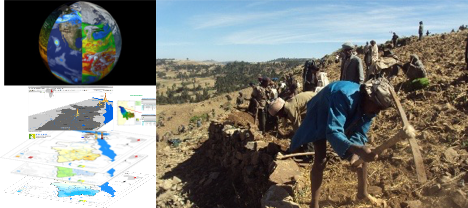
Healthy landscapes and seascapes offer vital services for nature, people, and economies. These services include jobs, biodiversity habitats, clean water, climate regulation, erosion control, crop pollination, soil fertility, and flood control. Land degradation poses a significant threat to the global economy. Estimates indicate that it could reduce global GDP by 10 percent between 2021 and 2030, affecting 3.2 billion people--particularly the poorest 40 percent.
However, about 40 percent of the world’s land is degraded, with 100 million more hectares added each year. Land degradation results from a complex interplay of environmental, economic, and social factors that, if not managed completely, can lead to irreversible damage from a reduction of ecosystem services. There is a need for land and associated natural resources to be better managed to improve drylands/rangelands, forests, coastal areas and other landscapes.
Land degradation results from a complex interplay of environmental, economic, and social factors that, if not managed completely, can lead to irreversible damage. The health of the world’s landscapes is under threat. Forests are felled, grasslands are overgrazed, wetlands are drained, and coral reefs are bleached. These changes compromise the ecosystems that support life, disrupt economies, and jeopardize community well-being.
There is increasing awareness of the need to develop more integrated multi-sectoral approaches to address this critical challenge for a livable planet. The UNCCD aims for land degradation neutrality by 2030 by restoring 1.5 billion hectares of land. The Convention for Biological Diversity targets restoration of 30 percent of all degraded ecosystems and conservation of 30 percent of Land, Waters, and Seas by 2030. This will require a range of investments from public and private sector sources to create new jobs and opportunities for people while improving the health of the economy and the planet.
In this context, an integrated landscape approach is critical to effecting change and building resilience into landscapes globally. A landscape is a socioecological system with spatial and geographic boundaries and functions and can be defined in different ways. A watershed, an administrative unit of government, or an ecological area can all be landscapes. Landscapes provide many social, economic, and ecosystem/environmental services and benefits that can be leveraged through an integrated and sustainable landscape approach. Landscapes are an appropriate and effective unit for managing ecological assets given the interconnected nature of activities and management impacts within a landscape both locally and regionally. Indeed, evidence has shown that the landscape approach can generate multiple benefits, including socio-economic and ecological gains. The landscape approach considers the plethora of interacting social, economic and environmental elements across a geography and takes a spatial and socio-economic approach to managing the resources (water, land, forests, biodiversity, agricultural systems) to support and bolster ecosystem health and productivity and the livelihoods that depend on these ecosystems.
The World Bank Group is scaling its investments in landscape management across its clients and has reflected landscapes in itsCorporate Scorecard. It has also initiated a new 10-year Livable Landscapes Academy to improve access to knowledge on innovations and evolving global good practices in solution areas related to technology, financing, and policies and regulations to help scale activities on the ground for more vibrant landscapes that create jobs and contribute to a range of socio-economic and environmental services.
This Livable Landscapes eBookis part of the global knowledge curation activities (a new 10-year Global Knowledge Platform and the WBG Knowledge Academy) to leverage digital technologies to improve access to insights for modern landscape management.The Livable Landscapes eBook is part of the Livable Landscapes Academy, described in detail in the Annex here. This overall ePackaging is expected to grow over time to include better access to data, analytics, AI and knowledge resources and enable those working on addressing landscape degradation to learn from their counterparts around the world. It is also expected to be leveraged for the knowledge exchange and impact program activities planned under the Academy to help translate and customize this knowledge for specific settings.
This e-book collates information on landscapes and the landscape approach globally to guide the planning and prioritization work of World Bank teams, clients, and development partners globally. Specifically, this eBook provides the following information:
A comprehensive exploration of the environmental, economic, and social challenges posed by landscape degradation and a pathway forward through protection, degradation reduction, and land restoration.
A framework on how to move to an integrated landscape approach to address the drivers of land degradation and potential challenges and opportunities in addressing these drivers.
An exploration of innovative and emerging solutions and strategies to address these issues through integrated landscape management, including case studies of where the landscape approach has been successful to date.
A discussion of an emerging solution set that includes emerging technologies, nature-based solutions, institutional collaboration and coordination, job creation, and innovative financial instruments and frameworks.
Attention to data and information, institutions and policy, and investments will be critical to further advancing the landscape approach. Already, several projects have been implemented, and others are underway and in development with a landscape approach lens in the region. These projects will benefit from leveraging best practices and lessons learned from other regions globally, and from integrating advances in data and information into the project cycle. Greater institutional cooperation and enabling policy development will likewise support the implementation of effective landscape approaches. Finally, investments in human capital and infrastructure will be critical to sustaining outcomes over time.