Looking Ahead
The Livable Landscapes Academy
The Livable Landscapes Academy is a comprehensive 10-year Global Knowledge Platform which aims to develop capacity to avoid, reduce, and restore degraded landscapes at scale. It focuses on three nested activity levels including: knowledge curation, knowledge exchange, and impact program (providing customized technical assistance to countries).
The Theory of Change for this Academy involves facilitating a move to scale up work to reduce the drivers of degradation to move towards more sustainable, climate-resilient landscapes supporting enhanced ecosystems, green jobs and more resilient communities.
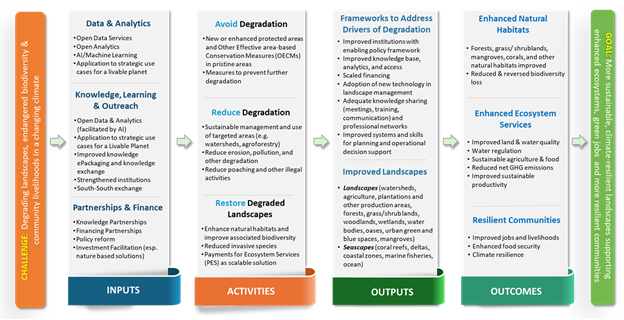
The results and outcomes framework for the LLA follows the program’s ten-year nested structure and is organized around the three inter-related program components—Knowledge Curation, Knowledge Exchange, and the Impact Program—which together drive a logical progression from foundational knowledge to country-level impact.
1. Knowledge Curation focuses on compilation and e-packaging of data/analytics (including state-of-the-art open data and AI tools) and learning resources, identifying gaps in the existing knowledge base, and creation of self-paced knowledge modules. This component will include an AI-powered search tool to match the supply and demand for landscapes-related knowledge and data.
2. Knowledge Exchangeinvolves in-person, hybrid, or virtual learning to facilitate targeted peer-to-peer learning and knowledge exchange (with focus on South-South knowledge exchange and field visits to large-scale restoration programs).
3. The Impact Programincludes customized technical assistance to select countries to support scaling landscape outcomes in targeted countries. The Impact Program would be targeting countries that have a high level of readiness, technical capacity, and political will aligned to bring their landscapes programs to the next level. This program will be demand-driven and tailored to the needs of each targeted country.
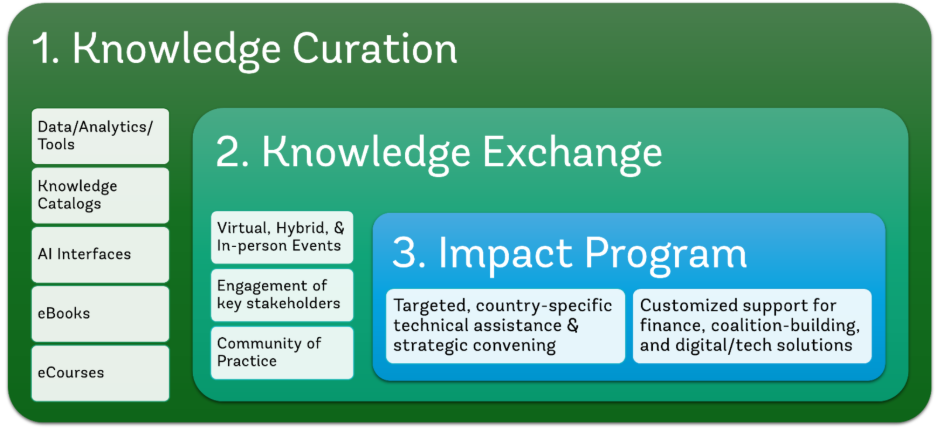
This structure ensures a clear line of sight from curated knowledge to exchange and, ultimately, to contribute to measurable, on-the-ground outcomes aligned with WBG corporate scorecard priorities.
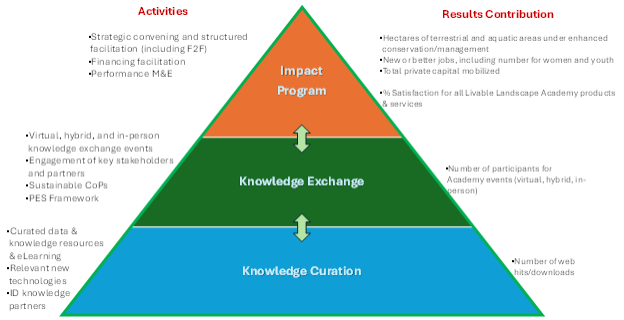
Building on a strong foundation of knowledge curation and exchange, the Impact Program will initially scale a broad concept of the Payments for Ecosystem Services (PES) model where payments are made to actors on the ground in return for ecosystem services. This model, sometimes also referred to as “eco-compensation”, would help create incentives for the stewards of the land to avoid, reduce, or restore degraded ecosystems, especially when combined with access to technologies and other good practices in a manner that is sensitive to the needs of each landscape and its residents. Payors and payees may be any combination of public and/or private entities. Land restoration projects that rely on the PES model are widely recognized as strong job creators and private capital mobilizers. For example, the Great Green Wall Initiative, which aims to restore 100 million hectares across the Sahel by 2030, is expected to create 10 million jobs.
Over the lifetime of the Academy, other scalable models will also be explored for use in scaling-up – e.g. apps to facilitate PES-like approaches, scaled financial instruments such as restoration bonds, and other promising emerging paradigms.
The Academy seeks to engage targeted stakeholders related to technology, policies & instruments, and financing.
| Topic Group | Targeted Stakeholders | Knowledge Curation | Knowledge Exchange | Impact Program |
|---|---|---|---|---|
| Technology | Government officials, Tech companies/experts, academia, CSOs, Community Groups, Indigenous leaders |
|
|
|
| Policies & Instruments | Government officials, NGOs & Community leaders |
|
|
|
| Financing | Government officials, Private Sector |
|
|
|
The Academy will strengthen internal (to WBG) and external partnerships to help target the knowledge and convening activities to scale results on the ground.
This eBook is part of the knowledge curation activities of the Academy. Learn more about this new generation of World Bank Group Academies here.