Solution Areas
There are many solutions that are being used to scale work on protecting and restoring landscapes, with case studies and best practices available globally. The initial solutions under the LLA that are captured in this e-book focus on job creation, incentivizing commodity production, and promoting economic activity through developing and scaling improved landscape management, restoration practices, and supportive policies. The LLA supports sustainable and multifunctional land management approaches rather than single-objective restoration. This will be achieved through targeted solutions in three areas: (1) policy and regulation; (2) technology; and (3) innovative finance. The benefits of applying solutions in these areas are highlighted by the statistics below.
-
Every US$1 invested in restoring degraded landscapes can generate US$7–30 in economic benefits.
Source: WRI -
87% of the US$540 billion in annual agricultural producer support is price-distorting and environmentally or socially harmful.
Source: FAO -
Nature-based solution finance must rise from about US$220 billion to US$571 billion annually by 2030 to meet global biodiversity, climate and land-restoration targets.
Source: UNEP -
Early-warning systems can provide a nearly tenfold return on investment while reducing climate-related losses.
Source: WMO -
Agroforestry occurs on more than 43% of agricultural land globally and supports landscapes where over 900 million people live.
Source: FAO -
A Niger programme restored 30,000 hectares of degraded land and recovered nearly 190,000 hectares through Farmer Managed Natural Regeneration.
Source: IFAD -
Mangroves avert an estimated US$57 billion in flood damages each year across China, India, Mexico, the United States and Viet Nam.
Source: IUCN -
Only 0.6% of annual agricultural budget support across 54 countries targeted environmental public goods between 2021 and 2023.
Source: OECD
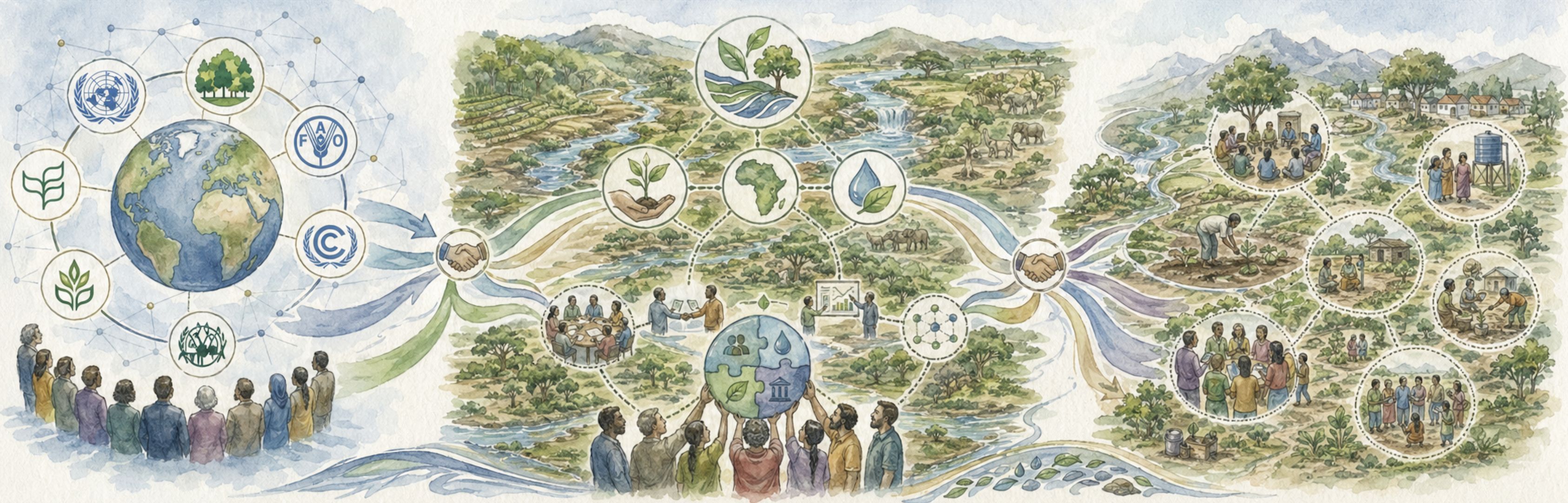
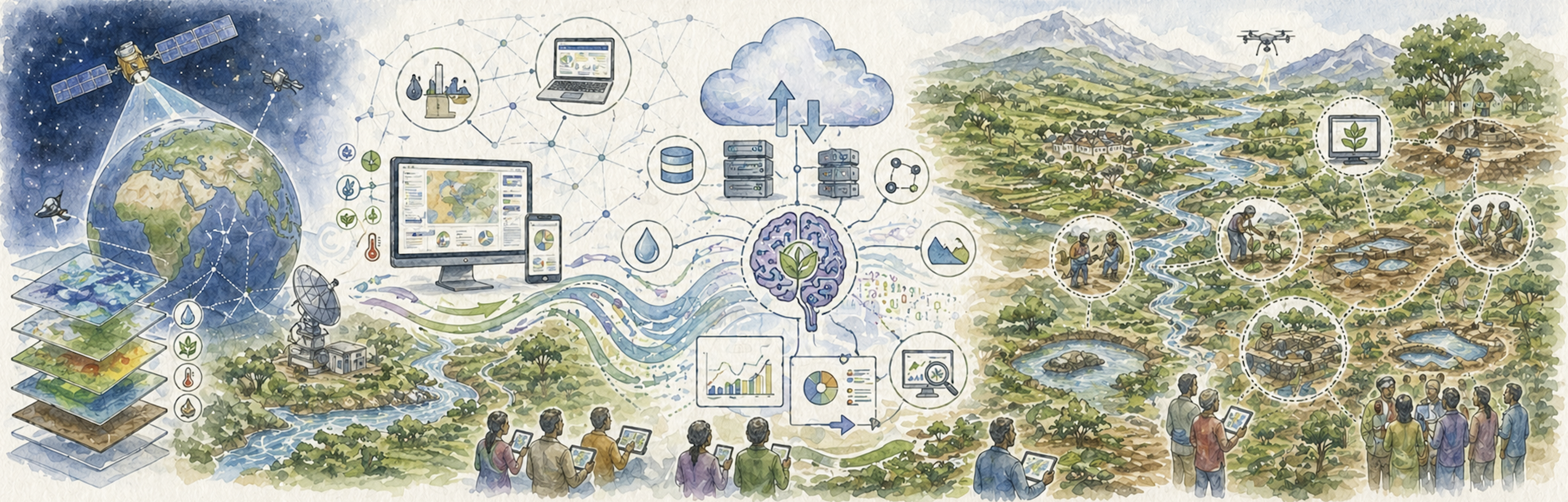
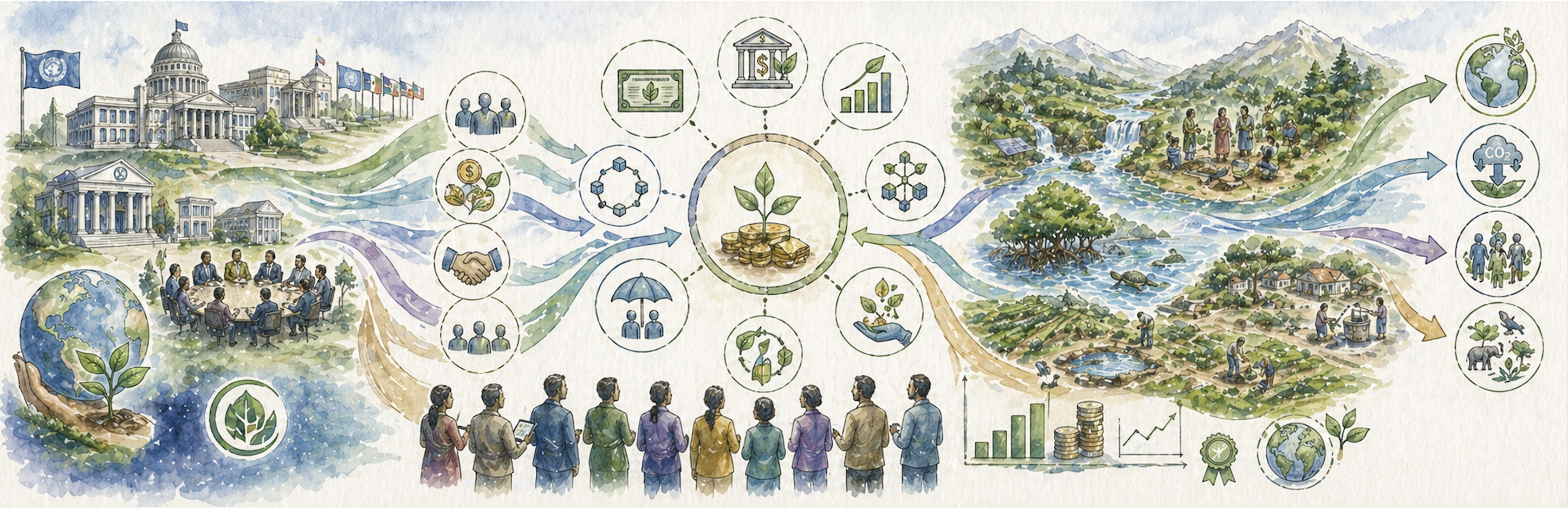
Key solution options featured in this e-book that can unlock landscape-scale benefits include enabling policies and regulations, including strengthening and modernizing the institutions that promulgate these enabling conditions; technology, including digital and physical technology; and financing and economic incentives, including innovative financial sources and structures. The table below summarizes these solution areas by landscape type, providing a summary for landscape management overall, and then for drylands, forests, and coastal ecosystems. Critically, these solution areas can interact and work together in the framework of integrated landscape management, a powerful tool that encourages integrated planning of solution areas to maximize landscape-scale social, economic, and environmental benefits.
| Landscape | Policies & Regulations |
Technology
🌐
🌱
|
Financing & Incentives |
|---|---|---|---|
|
Overall
EXPAND ➔
|
Enabling policies (e.g. on repurposing agricultural subsidies, land use planning, protected area management, secure property rights, grazing rights/exclusion, PPP, natural resource regulations, benefit sharing)
Strengthening/modernizing institutions (e.g. watershed to micro watershed governance, regional to local/community levels, cross-sector coordination, meaningful stakeholder engagement, private sector facilitated value chains/SME, partnerships)
|
Digital Monitoring (earth observation, sensors, surveys), modern cloud data/analytics (incl. hydrology, erosion, ecosystem services, climate resilience), decision support systems for planning and operations, digital MRV, payment systems, stakeholder platforms (incl. information access, communication, alerts, hackathons), tech internships, AI-facilitated knowledge access, digital twins, digital enabling systems for other solutions
Physical Assisted Natural Regeneration; SLWM (e.g. terracing, check-dams, slope stabilization, buffer plantations), improved seeds/agricultural water management/inputs, solar innovations, implements, processes
|
Improving Financing (e.g. blended finance, risk management, outcome bonds, C & adaptation finance, repurposing subsidies)
Incentivizing action (e.g. PES, fiscal transfers)
|
| Drylands | Rangeland governance; drought insurance, social safety nets |
Digital Drought forecasting and early warning, climate resilience scenario planning
Physical Farmer Managed Natural Regeneration; water harvesting (zai, demi-lunes); drought-resilient seeds
|
Concessional lending; PES for groundwater/fodder; climate adaptation finance; support value chains |
| Forests | Secure community forest tenure; strengthen enforcement; cross-sector coordination, forest value chains, eco-tourism |
Digital Forest management information systems, dMRV for forests and forest C and soil C, smart fire management digital support
Physical Agroforestry; silvo-pastoral systems; enrichment planting; fire-smart management
|
Blend public/private finance; concessional lending; green bonds; biodiversity/water crediting; support value chains; PES for forest protection, afforestation, ecosystem enhancement |
| Coastal | River-basin management; Blue economy development planning, coastal erosion and pollution management (incl. regionally), reform aquaculture/zoning, reef ecosystem management |
Digital Shoreline tracking, climate resilience and sea-level rise scenario planning, Blue C suitability mapping
Physical Civil works; mangrove planting; salinity barriers; nature-based coastal defenses
|
Blue carbon finance; PES for Nature based Solutions |
| Policies & Regulations | |
|---|---|
| Technology (Digital) | |
| Technology (Physical) | |
| Financing & Incentives |
Payments for Ecosystems Services: Analysis & Insights