Strengthening and Modernizing Institutions
Strengthening and modernizing institutions is another key element of successful integrated landscape management. Management of environmental and other resources at a landscape scale requires multi-sectoral coordination and communication in decision-making across different public agencies, communities, and potentially various entities in the nonprofit and private sectors. Institutional work can happen at the global, regional, national, and local levels. Multi-sectoral decision-making across institutions needs to be supported by viable institutional frameworks that help specify roles and responsibilities in landscape management activities, how information might be coordinated across agencies at different administrative levels and with different mandates, and how capacity building might be increased. This section describes several global, regional, and local institutional initiatives and programs that are working towards supporting landscape management.
Global
The Living Landscape Academy and the landscape approach (integrated landscape management) at the center of it is central to multiple global institutional efforts to restore resiliency and health to the environment. Conservation, sustainable use, and restoration of land resources sit at the convergence of the United Nations Convention to Combat Desertification (UNCCD), the Convention on Biological Diversity (CBD), and the UN Framework Convention on Climate Change (UNFCCC). This section explains each of these agreements and frameworks, along with other material institutional structures such as the Sustainable Development Goals (SDGs).
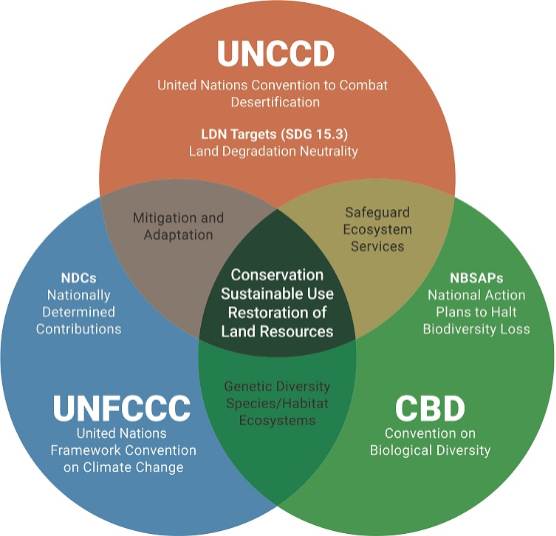
Source:United Nations
United Nations Convention to Combat Desertification (UNCCD)
The United Nations Convention to Combat Desertification (UNCCD) is the only legally binding international agreement focused solely on land degradation, desertification, and drought. Since 1994 when it was established, UNCCD has been working with over 190 countries to promote sustainable land management and achieve land degradation neutrality (LDN) by 2030—a key target under SDG 15. The UNCCD aims to achieve land degradation neutrality – restoring a hectare of land for every hectare that is degraded - by 2030 by restoring 1.5 billion hectares of land. Global voluntary commitments to restore degraded land have reached one billion hectares by 2030, almost half of these pledged under UNCCD. Through its LDN Target Setting Programme , the UNCCD assists countries to assess land degradation, set restoration goals, and implement policies that balance land loss with recovery. UNCCD implements the Land Degradation Neutrality Fund , which organizes private and public investments for sustainable land use projects globally. The UNCCD also leads global advocacy through events like Desertification and Drought Day, raising awareness on the importance of healthy land for climate resilience, biodiversity, and food security. The video below discusses the importance of working towards land degradation neutrality.
CIFOR-ICRAF
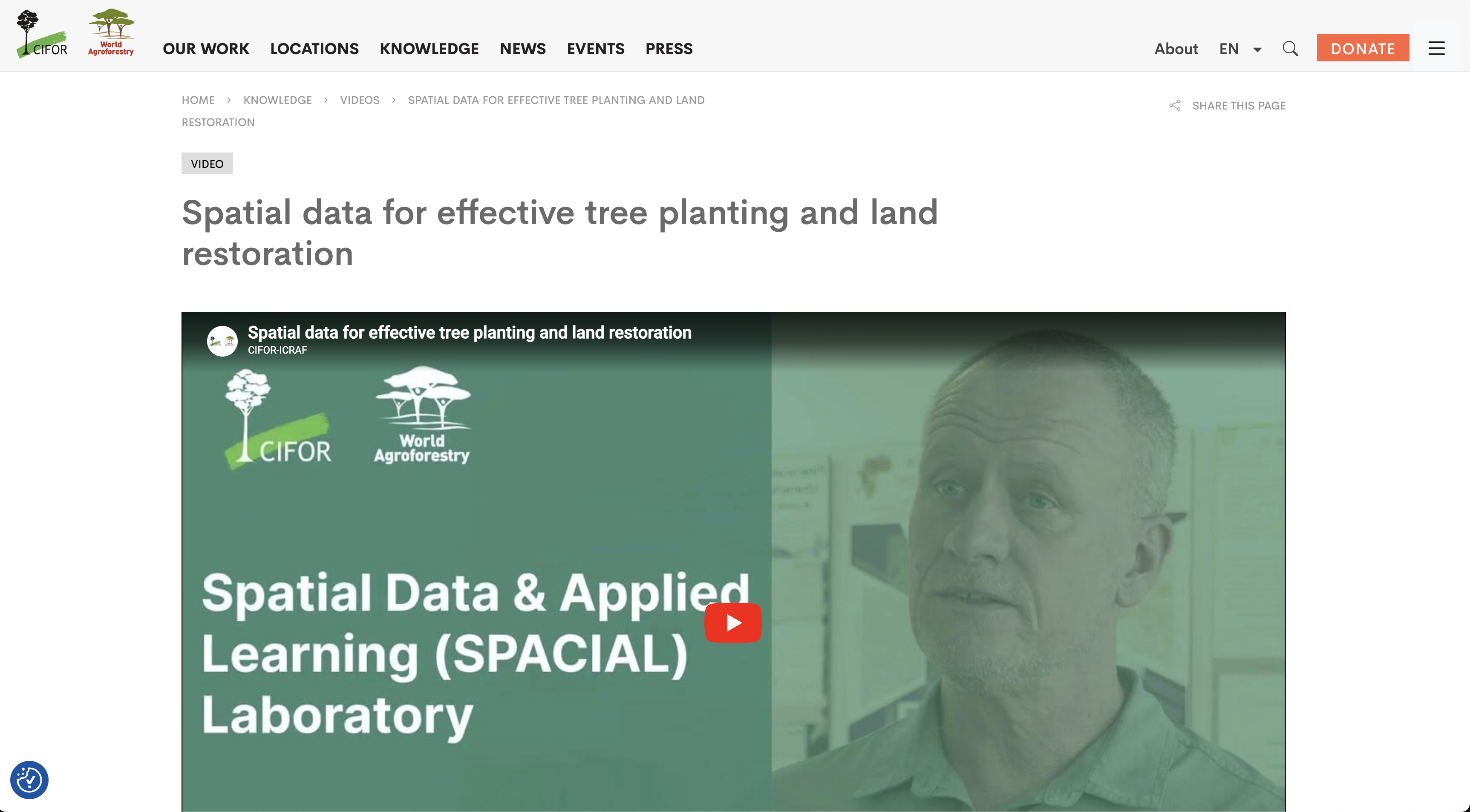
The Center for International Forestry Research and World Agroforestry (CIFOR-ICRAF) works across the following sectors where trees can enable positive change: biodiversity, climate, food, value chains, and equity. CIFOR-ICRAF has a heavy presence in Africa and Asia, but works globally in other regions as well, such as Latin America and Europe. The organization works to generate data, information, and knowledge products to inform sustainable development efforts around the world. For example, as the video below shows, CIFOR-ICRAF has provided spatial data to guide tree planting and land restoration activities.
Food and Agriculture Organization (FAO)
The Food and Agriculture Organization (FAO) is an agency of the United Nations focused on improving food security and reducing hunger and poverty. The FAO’s Land and Water Division works on integrated landscape management , through which the organization implements projects funded by donors such as the Global Environment Facility (GEF). The FAO also participates in the World Overview of Conservation Approaches and Technologies (WOCAT).
Convention on Biological Diversity (CBD)
The Convention on Biological Diversity (CBD) recognizes land degradation as a major driver of biodiversity loss, acknowledging that sustainable land use and healthy ecosystems are vital for achieving global environmental goals. The CBD addresses land degradation through multiple integrated approaches:
Ecosystem-based Approaches: The CBD promotes ecosystem-based approaches to land management that combine biodiversity conservation with efforts to combat land degradation and desertification. These approaches help sustain key ecosystem services, including soil fertility, water regulation, and carbon sequestration. In the agricultural sector, the CBD encourages ecologically intensified agricultural practices that enhance both productivity and ecosystem resilience.
Kunming-Montreal Global Biodiversity Framework(KMGBF):The KMGBF, adopted under the CBD in 2022, sets ambitious goals for ecosystem restoration. Target 2 specifically calls for the restoration of at least 30% of degraded terrestrial, inland water, and marine ecosystems by 2030 , directly linking land restoration to biodiversity conservation.
Synergies with Other Conventions: The CBD works in close coordination with the UN Convention to Combat Desertification (UNCCD) and the United Nations Framework Convention on Climate Change (UNFCCC) to advance integrated land-use planning and promote Land Degradation Neutrality (LDN). This fosters coherence across biodiversity, climate, and land agendas.
Support for Indigenous Peoples and Local Communities (IPLCs): The CBD highlights the critical role of Indigenous Peoples and Local Communities in land stewardship and restoration. Their traditional knowledge and sustainable land-use practices are vital for reversing degradation and sustaining biodiversity-rich landscapes.
National Biodiversity Strategies and Action Plans (NBSAPs): The CBD encourages countries to address land degradation within their NBSAPs, ensuring alignment between national restoration strategies and the goals of the KMGBF, including ecosystem restoration and sustainable land management.
United Nations Framework Convention on Climate Change (UNFCCC)
The United Nations Framework Convention on Climate Change (UNFCCC) addresses land degradation through its focus on climate change mitigation and adaptation, recognizing that land degradation, desertification, and climate change are closely interconnected challenges. The primary mandate for addressing land degradation lies with the United Nations Convention to Combat Desertification (UNCCD), the UNFCCC supports related efforts through several mechanisms and frameworks that promote sustainable land use and ecosystem resilience.
Reducing Emissions from Deforestation and Forest Degradation(REDD+):REDD+ is a framework under the United Nations Framework Convention on Climate Change (UNFCCC) that provides financial incentives to developing countries for reducing emissions from deforestation and forest degradation. It also supports the conservation, sustainable management of forests, and enhancement of forest carbon stocks by promoting sustainable forest practices. REDD+ contributes directly to combating land degradation, enhancing land productivity, and supporting climate-resilient development pathways.
Promoting Climate-Smart Land Use: The UNFCCC promotes sustainable land use practices that enhance resilience to climate change and reduce land degradation. These include Climate-smart agriculture (CSA) viz., conservation of native crop varieties, organic farming, integrated pest management, conservation of pollinators, crop diversification, and use of climate-resilient seed varieties. Agroforestry and sustainable pasture management to restore degraded land and improve ecosystem services.
Integration into Nationally Determined Contributions (NDCs):Countries incorporate targets for addressing land degradation, desertification, and ecosystem restoration within their NDCs, thereby aligning their climate mitigation and adaptation strategies with sustainable land management practices.
Support for Climate Change Adaptation practices:The UNFCCC supports adaptation projects in enhancing land productivity and reducing degradation risks in climate-vulnerable ecosystems like drylands, coastal zones, and mountain regions.
Climate Finance for Restoration:The UNFCCC facilitates access to financial mechanisms for land restoration and sustainable management; these include: the Green Climate Fund (GCF) and the adaptation Fund. These support initiatives in reforestation, water conservation, and resilient land use planning, helping countries reduce degradation while building climate resilience.
Regional
Globally, countries and communities are responding to land degradation with bold regional initiatives that restore landscapes, improve livelihoods, and build climate resilience. These initiatives, supported by governments, multilateral organizations, and other stakeholders, reflect the increasing recognition that restoring land is critical to sustainable development. Below are some of the regional initiatives that drive large-scale landscape restoration and sustainable land management across Africa, Asia-Pacific, Latin America, and Europe.
In Latin America and the Caribbean, Initiative 20x20 is a country-led effort seeking to change the dynamics of land degradation in Latin America and the Caribbean through the protection and restoration of 50 million hectares of forests, farms, pastures, and other landscapes by the year 2030. The initiative, which was launched at the COP 20 in Lima in 2014, supports the Bonn Challenge and the New York Declaration on Forests, global commitments to bring 350 million hectares of the world’s deforested and degraded land into restoration by 2030.
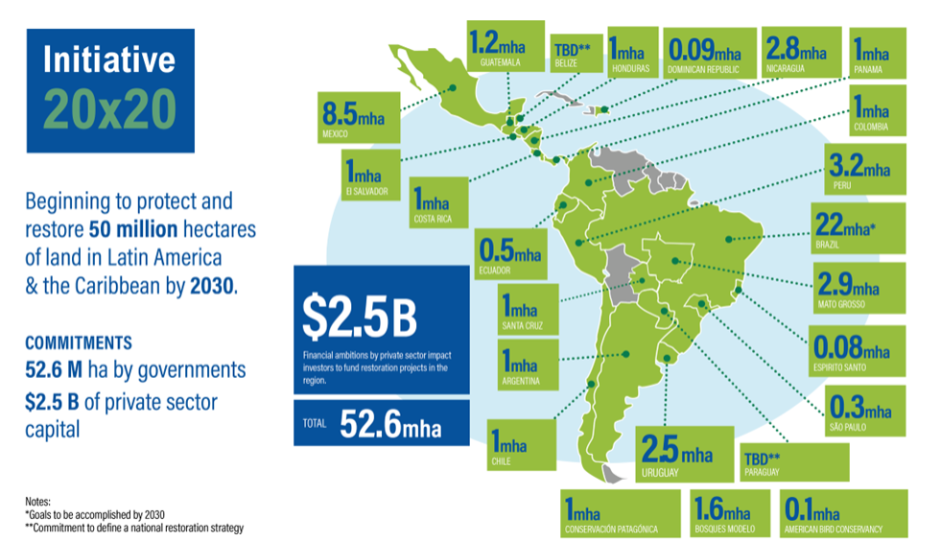
Source: Initiative 20x20
In Europe, Forest Europe develops common strategies for its 45 signatories on how to protect and sustainably manage their forests by monitoring landscape health across the continent. It promotes biodiversity, ecosystem services, and policy alignment for long-term forest resilience.
The Central Asian Desert Initiative (CADI) was introduced as part of a broader effort to promote sustainable land use and conservation in the region’s unique desert ecosystems. Initiated by the Michael Succow Foundation , the University of Greifswald, and the Food and Agriculture Organization (FAO) Subregional Office for Central Asia, the project supported the partner institutions in developing inclusive land use plans, establishing protected areas and World Natural Heritage sites, and strengthening compliance with international environmental agreements such as the CBD and UNFCCC. CADI also enabled collaboration through stakeholder networking, scientific partnerships, policy advice, and capacity-building activities aimed at preserving desert biodiversity and promoting resilience in these fragile landscapes in Kazakhstan, Uzbekistan, Turkmenistan, and Mongolia
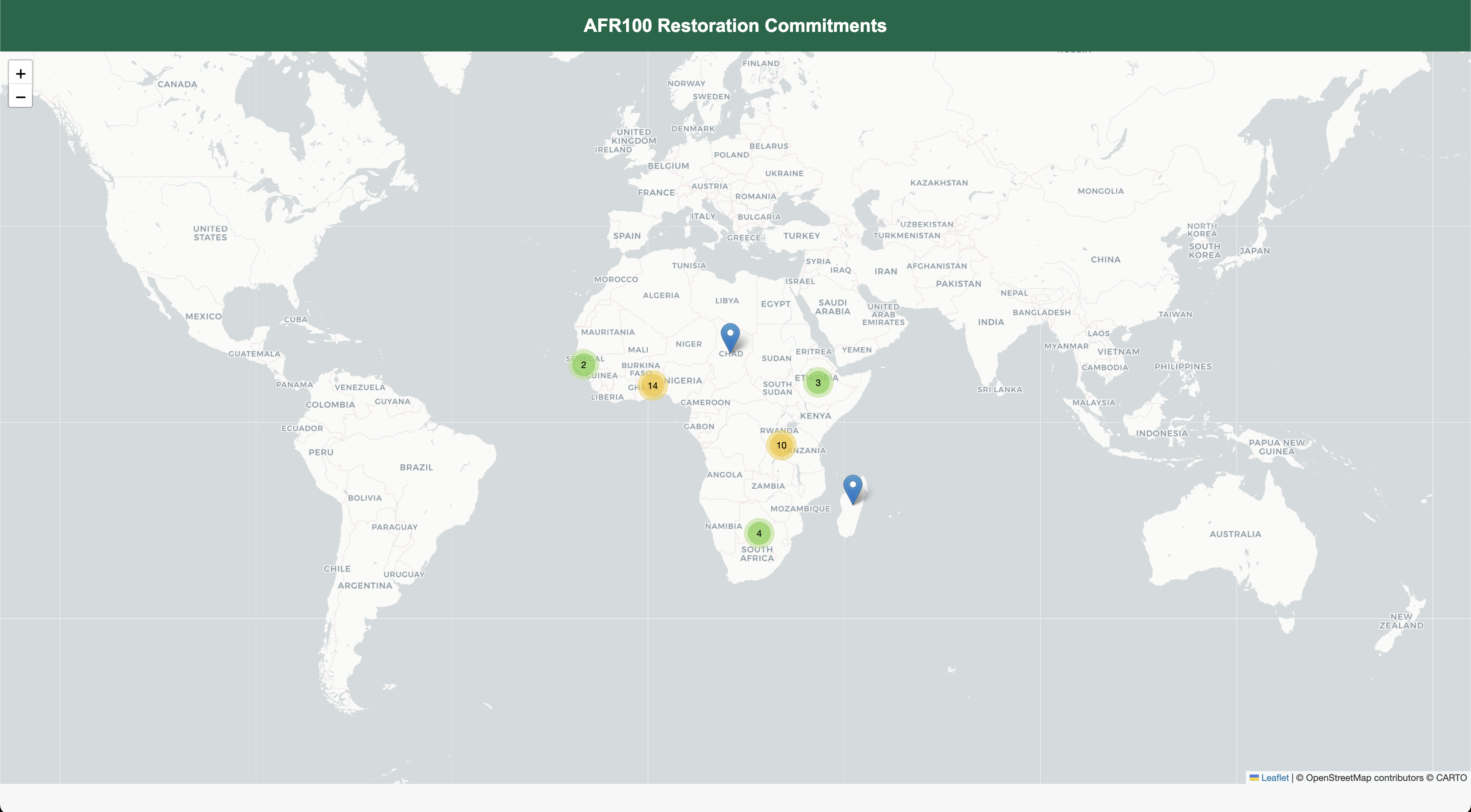
In the Africa Region, AFR100 (African Forest Landscape Restoration Initiative) is an Initiative that combines domestic strategies with support from World Resources Institute, NEPAD and the World Bank. It brings together more than 30 countries in the region committed to restoring 100 million hectares of degraded land by 2030.
Local
At the local level, watershed organizations are a local institution that can seek to engage communities in watershed-scale decision-making for sustainable water outcomes. In India, the World Bank’s Sujala Project in the state of Karnataka (see video below) engaged communities through participatory watershed planning.
Private and Nonprofit Sector
The private and nonprofit sectors are also playing an important role in strengthening and modernizing institutions. For example, the World Resources Institute (WRI) together with several other nonprofits established TerraFund for AFR100, a fund that issues RFPs for organizations across the continent to engage in restoration work. Recent learnings show the benefits of engaging in this type of small low interest loan, widespread model and how the effort is adaptively learning from project results.
The Nature Investment Lab is another initiative founded by the private sector: “The Nature Investment Lab (NIL) is a laboratory created to attract and scale investments in Nature-Based Solutions (NBS). It brings together the private sector, finance, government, and civil society to drive impactful climate investments and actions in regenerative agriculture, forest restoration and the bioeconomy.”